


A structural interlayer earns its name after the pane has failed. Malvinder Singh Rooprai, of Kuraray, ran the comparison on broken glass, and showed what arrives on site when the specification is substituted.
Kuraray makes the interlayers that laminated glass is built around, and Malvinder Singh Rooprai divided them the way the company does: structural on one side, non-structural on the other. The structural ones are for the cases where glass stops being a decorative element and becomes a load-bearing one, holding the live load of somebody leaning on a balustrade, or of people standing on a floor. Choose the wrong glass in one of those places, he said, and things go wrong.

Two of them, and what separates them
There are two structural families. One is ionoplast, which is where SentryGlas sits; the other is a stiff PVB, sold as Trosifol Extra Stiff Pro and recommended for interior applications. The distinction that matters is temperature: the ionoplast keeps its stiffness above 30 degrees, where a PVB is losing its. That is why it has become the reference for architects, designers, engineers and consultants, and why it turns up on mega projects around the world.
Plotted as Young's modulus against temperature, the ionoplast curve sits at the top of the chart and holds a high modulus from 20 degrees to 60. The stiff PVBs, Kuraray's own and other suppliers', run below it, and an interior PVB is highly compliant to temperature by design. Rooprai's point was that the modulus number is not the only comparison: post-breakage strength, design temperature, performance in the salt spray test and suitability for open-edge laminates all separate one interlayer from another.

What the tests show
Both of the tests that follow are proxies for one moment: the instant after the pane has already broken, when the interlayer is the only thing still holding the two halves together and whatever is leaning on them.
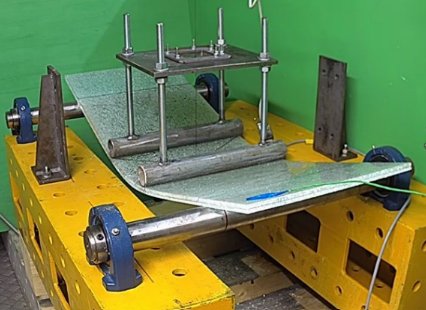
The useful test is the one performed on broken glass. In a four-point bend, the pane is deliberately broken and then loaded: after seven and a half minutes the laminate made with the stiff PVB was still showing minimal deflection, where another supplier's had moved appreciably.
The collapse-load test asks the balustrade question directly. Break the glass, apply a point load, and see how much live load the laminate still carries, which is what happens when a person puts their weight against a railing that has already failed. Measured that way, the collapse load was almost twice the other suppliers'.
Specifying it, and what turns up instead
SentryGlas is a registered trade name and Kuraray is its only maker. Rooprai's warning was that several manufacturers now market a substitute as an equivalent, under the label SGP, and that it is not the same material. His request to architects and façade consultants was procedural: check which glass processors are certified, and buy through them, so that the person paying for the specification receives it.
He had the photographs to make the case. One project showed very high haze. Another, a glass fin application, had cracks in the interlayer itself rather than in the glass. A balustrade put through a swing-back impact test collapsed where it should have stood erect, and that test was run at only 20 degrees. Measurements across three suppliers found worse yellowness and haze than Kuraray's product, and peel adhesion from two of them was below par, which is what produced the delamination visible in the laminates.